
125 Hippie Quotes to Inspire Peace, Love, and Freedom
The hippie spirit has always been about slowing down, loving openly, and living in tune with the world around you. It shows up in wildflower fields, bare feet on warm grass, long conversations, and the simple belief that kindness is worth more than status. These quotes are for anyone who feels pulled toward that gentler way of living.
This collection of 125 hippie quotes covers peace, love, and freedom, short one-liners, funny free-spirit lines, nature and earth-loving words, music and good vibes, and easy captions for Instagram. All quotes are original, written in the free-spirited mood. Save your favorites, pair them with your next sunset or festival photo, and let a little peace travel with you.
Hippie Quotes to Inspire Peace, Love, and Freedom
These opening quotes capture the free-spirited heart of the movement, a good fit for any card, caption, or message.
• Live softly, love loudly, walk free.
• Peace begins the moment you stop trying to win.
• A kind heart is the best kind of rebellion.
• Choose love, then choose it again tomorrow.
• Freedom is a feeling before it's a place.
• Wear flowers in your hair and nothing heavy in your heart.
• The world gets lighter when we share what we have.
• Be gentle with people, they're carrying more than they show.
• Let your spirit wander where your feet cannot.
• Love is the only currency that grows when you spend it.
• Don't chase the crowd, follow the music you hear inside.
• Peace is not the absence of noise, it's the presence of kindness.
• Be the calm in someone else's storm.
• A free spirit is simply someone who stopped pretending.
• Collect moments, not things.
• Make room for everyone at the table.
• Trust the slow road, it has the best views.
• Where there's love, there's always enough.
• Plant kindness wherever you go and see what grows.
Short Hippie Quotes
For a quick, free-spirited message, these short lines carry plenty of good energy in very few words.
• Peace and good vibes.
• Stay wild, stay kind.
• Love first.
• Free spirit, soft heart.
• Barefoot and happy.
• Bloom anyway.
• Good energy only.
• Slow down, breathe in.
• Wildflower soul.
• Spread love, not worry.
• Follow your own sunrise.
• Be here now.
• Make peace, not noise.
• Soft heart, wild mind.
• Gentle always.
• Chase the light.
• Kindness is cool.
• Go with the flow.
Funny Hippie Quotes
Free spirits have a sense of humor too, and these quotes poke fun at barefoot walking, incense, and cheerfully ignoring your inbox.
• I'm not lost, I'm just taking the scenic route through life.
• My aura is bright, my schedule is blank.
• I came for the peace and stayed for the snacks.
• My natural habitat is a hammock.
• I'm not late, I'm just on cosmic time.
• I own more tie-dye than responsibilities.
• Good vibes, bad Wi-Fi, no regrets.
• Inner peace is great, but have you tried a long nap?
• My yoga mat is mostly decorative, but my intentions are real.
• I told the universe my plans, and it laughed kindly.
• Shoes are optional, but snacks are not.
• I meditate on what to eat for dinner.
• I like my coffee strong and my schedule loose.
• Sorry I can't talk, I'm busy being calm.
• My to-do list is mostly "breathe" and "see what happens."
• I tried to be on time, but the sunset was just too good.
• I'm an old soul with a new phone and no idea where it is.
• Plot twist: the incense was the only thing keeping me organized.
Hippie Quotes About Peace and Love
At the heart of it all are peace and love, and these quotes speak to compassion, connection, and treating one another with care.
• Love is the quiet answer to almost every question.
• Peace is built from small, daily acts of kindness.
• When in doubt, choose compassion.
• A gentle word can end an argument before it starts.
• Heal what you can, forgive what you can, and rest.
• Listening is a loving thing to do.
• We rise by lifting each other up.
• The best revolutions begin in a kind heart.
• Hold people with open hands, not clenched fists.
• Be generous with your smile, it costs nothing.
• Everyone you meet is quietly fighting something.
• Peace is a practice, not a destination.
• Share your light, there's plenty for everybody.
• Treat strangers like friends you haven't met yet.
• Let your love be bigger than your fear.
• A little patience can change an entire day.
• Love doesn't ask for proof, only presence.
• Where we find understanding, we find peace.
Hippie Quotes About Freedom and Living Free
Freedom here means living honestly and on your own terms, and these quotes celebrate open roads, open minds, and the courage to go your own way.
• Freedom is the road you choose, not the one you inherit.
• Live a life that feels like yours.
• Let go of what you think you should be.
• A wandering heart finds its own way home.
• Your path doesn't need to look like anyone else's.
• Be so free that fear gets bored of you.
• The best things in life are rarely scheduled.
• Choose joy over approval.
• Own less, live more.
• Open road, open mind, open heart.
• You were not meant to fit in a box.
• Take the long way, you'll see more.
• Freedom is knowing you can begin again.
• Say yes to the unplanned.
• Don't let a crowded schedule steal a quiet life.
• Courage is simply following your heart in public.
• Trade the rush for a slow sunrise.
• Be the author of your own wandering story.
Hippie Quotes About Nature and the Earth
Nature is where the free spirit feels most at home, and these quotes honor the earth, the seasons, and the quiet lessons of the outdoors.
• The earth is our oldest teacher and our softest bed.
• Walk barefoot and let the ground remind you who you are.
• Trees don't rush, and they still grow tall.
• Sit with a river long enough and it will teach you patience.
• The forest is a cathedral with no walls.
• Take only memories, leave only footprints.
• Wildflowers don't ask permission to bloom.
• When the world feels loud, go listen to the wind.
• Every sunrise is a quiet invitation.
• Grow something, and watch what it teaches you.
• Mountains remind us that stillness is strength.
• Let the rain wash away what you don't need.
• Nature never hurries, yet everything is accomplished.
• A garden is the gentlest kind of prayer.
• Breathe in the green and breathe out the gray.
• The moon reminds us that every phase has beauty.
• Rooted in soil, reaching for light.
• Earth gave us everything, so let's give it care.
Hippie Quotes for Instagram and Good Vibes
Perfect for pairing with a sunset, a festival photo, or a quiet moment outdoors, these short captions are easy to post and full of easy, free-spirited energy.
• Good vibes, good people, good day.
• Sun on my face, peace in my pocket.
• Dancing barefoot is my kind of therapy.
• Flower crowns and easy hearts.
• Chasing sunsets and good conversations.
• Living slow, loving big.
• Music in the air, nothing on my mind.
• Out in the wild, right where I belong.
• Stay golden, stay kind.
• Where the heart goes, I follow.
• Free to be exactly who I am.
• Sunshine, daisies, and a good playlist.
• Collecting wildflowers and kind words.
• Festival season, soul season.
• Just here for the good energy.
• Peace, love, and good vibes.
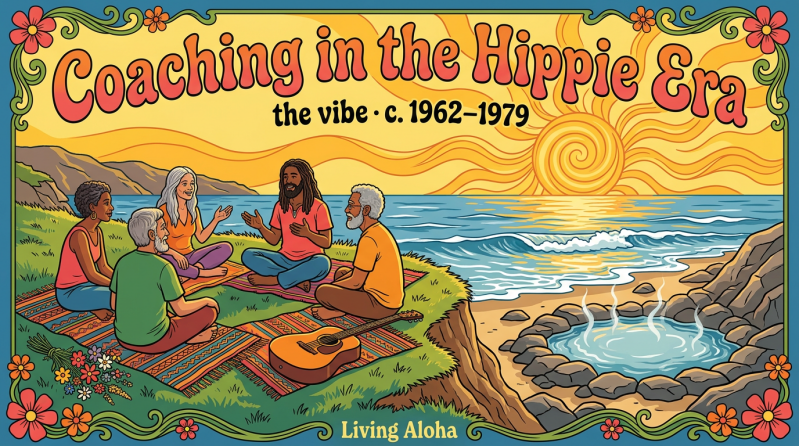
LIVING ALOHA · RESEARCH · C. 1962–1979
Coaching in the Hippie Era — the vibe
There was no job title “life coach” back then. What there was was something coaching-shaped — and it looked nothing like a private weekly video call. It was group-based, experiential, body-inclusive and retreat-centred: circles on the floor, hot springs at midnight, and a warm insistence that you are not broken.
Its home was the human potential movement— the Esalen Institute at Big Sur (founded 1962), encounter groups, Gestalt workshops, humanistic psychology, feminist consciousness-raising circles, communes, and, from 1971, Werner Erhard’s mass-market est trainings in hotel ballrooms. Its promise was not productivity or goal-setting. It was: you are already whole, you are blocked by social conditioning and repressed feeling, and direct experience — here, now, in your body, honestly witnessed by others — will free you to become what you could be.
Summary drawn from the British Psychological Society’s history of Esalen and the human potential movement and the World Religions & Spirituality Project’s Esalen timeline — full sources at the foot of this page. Researched 18 November 2026.
The sessions · Timeline · Values · Bookshelf · Language · Look & feel · Honest caveats · Borrow / leave
1 · WHAT IT ACTUALLY LOOKED LIKE
Shoes off. Sit in a circle.
Popular psychology in the 1960s shifted “from models of neurosis and adjustment to those facilitating personal growth and a fuller life.” The British Psychological Society puts the redefinition plainly: human-potential psychology “fundamentally redefined psychotherapy as a context for personal growth instead of recovery from mental illness, and it provided group experiences that were not as time- or money-consuming as traditional therapies.” That — growth for basically healthy people, in groups, in a weekend — is the direct ancestor of modern coaching.
A day at Esalen in the 1970s, as described by the World Religions & Spirituality Project: “begin the day with yoga or meditation, try out an Esalen massage, participate in an encounter group, sit Zen with a visiting monk, go to an after dinner lecture… and then take a late night soak in the hotsprings.”
Source: World Religions & Spirituality Project, Esalen timeline. Esalen’s approach also embraced Gestalt, psychodrama, transactional analysis, primal therapy, Zen Buddhism, astrology, art, dance and bodywork (British Psychological Society).
THE FLAGSHIP
Esalen Institute, Big Sur — 1962
Founded in 1962 on cliff-top hot springs at Big Sur, California, by Stanford graduates Michael Murphy and Dick Price, as “a small retreat and workshop centre” to explore what Aldous Huxley called “human potentialities” — integrating humanistic psychology with Eastern philosophy and holistic body-mind-spirit approaches. Early programme: weekend seminars in 1962 with Alan Watts, Aldous Huxley and Ansel Adams; Charlotte Selver’s sensory awareness (the foundation of Esalen Massage); Ida Rolf’s bodywork from 1964; Fritz Perls in residence 1963–1969; Maslow lectures 1962–1964.
It scaled by imitation: by 1971 it was “the model for more than 90 similar centres, known informally as ‘Little Esalens’,” and by the early 1970s an estimated 150–200 growth centres modelled on it existed across the US.
Sources: British Psychological Society · WRSP
THE CORE FORMAT
Encounter groups — “we all sat on the floor”
The era’s default session was not one-to-one. It was a small, relatively unstructured group telling the truth to each other in the present moment. Descended from Kurt Lewin’s late-1940s T-groups via Rogers, encounter groups emphasised “sensitivity training procedures for learning to become more aware of one’s actual experience in the moment and those of others.”
At Esalen, Will Schutz’s groups focused on participants’ relationships with one another rather than with a therapist. Esalen’s own memorial to Schutz describes his “open encounter” as an eclectic mix of “group therapy, psychosynthesis, bioenergetics, psychodrama, Gestalt, and anything else he deemed appropriate in the moment” — his goal “to recover deadened feelings and increase a person’s ability to be open and honest.” In groups, “we all sat on the floor! When people sobbed, you passed the Kleenex, but you also held them.” His “More Joy workshops” were five-day encounter groups, and his bestseller Joy (1967) “made encounter groups synonymous with Esalen.”
Sources: Esalen, Will Schutz memorial · WRSP · EBSCO Research Starters
THE HOT SEAT
Gestalt practice — Fritz Perls
Perls, co-founder of Gestalt therapy, lived and taught at Esalen, underlining “awareness of sensation, perception, bodily feelings, emotion and behaviour in the present moment.” The format was the opposite of a cosy chat: “Individuals in Perls’ Gestalt psychology workshops worked with him before an audience of other participants. While they were on the ‘hot-seat,’ volunteers acted out conflicts in their lives in vivid psychodramas that Perls interpreted. Perls’ Gestalt groups depended on his somewhat autocratic leadership.”
The famous spin-offs — the empty-chair dialogue (speaking to an imagined other, or another part of yourself, then swapping chairs) and dream work done in the present tense — are still used in coaching and therapy today.
Sources: British Psychological Society · WRSP
THE GENTLE POLE
Carl Rogers — the one-to-one that wasn’t directive
Instead of manipulating responses (behaviourism) or interpreting what a client “really” meant (psychoanalysis), Rogers advocated a “nondirective,” “client centered” approach “to facilitate a deepening of the clients’ own self-understanding” — Client-Centered Therapy (1951), On Becoming a Person (1961).
His three therapist “core conditions,” proposed in 1957 — congruence (genuineness, no professional façade), unconditional positive regard (acceptance without “only if…”), and empathic understanding— were offered in service of the person’s “actualising tendency.” In modern terms, Rogers is the origin of coaching’s “the client has the answers; hold a warm, non-judgmental space” stance.
Sources: EBSCO Research Starters · Simply Psychology, person-centred therapy
MASS-MARKET · 1971
est — coaching goes to the ballroom
Werner Erhard founded est (Erhard Seminars Training) in October 1971; the first course ran at the Jack Tar Hotel, San Francisco. It was a “two-weekend (6-day, 60-hour) course known officially as ‘The est Standard Training’,” loosely based on Zen Buddhism, aiming to transform one’s ability to experience living. Within a year: trainings in twelve major cities and over 62,000 graduates.
The format: about 200 participants in a hotel ballroom. “Trainers confronted participants one-on-one and challenged them to be themselves rather than to play a role that had been imposed on them by the past” — the aim being to shift from trying to get satisfaction to “actually being satisfied and experiencing themselves as whole and complete in the present moment.” The BPS summarises it as sold in “hotel ballrooms across the country, a sort-of cultish offshoot of Esalen,” where you were to “‘get it’ by discovering there was, actually, nothing at all to get.” est ran to December 1984 and was replaced by The Forum (later Landmark).
Sources: Erhard Seminars Training · British Psychological Society
DAILY PRACTICE
Transcendental Meditation & yoga
TM is “a technique of meditation in which practitioners mentally repeat a special Sanskrit word or phrase (mantra) with the aim of achieving a state of inner peacefulness and bodily calm,” promoted internationally from the late 1950s by Maharishi Mahesh Yogi. You were initiated by a teacher, given a mantra chosen for you, then meditated independently “twice a day for periods of 20 minutes each.”
Celebrity transmission mattered: the Beatles’ February 1968 stay at the Maharishi’s ashram in Rishikesh (with Mia Farrow, Donovan and Mike Love) drew worldwide media, and Life dubbed 1968 “The Year of the Guru.” Crucially for a coach: TM and yoga were framed as portable daily disciplines you do yourself, not sessions with an expert — the era’s equivalent of a morning practice.
Sources: Britannica, Transcendental Meditation · Philip Goldberg, American Veda (excerpt)
A WAY OF LIVING
Communes & consciousness-raising circles
Hippies “experimented with communal or cooperative living arrangements,” adopted vegetarian diets of unprocessed foods and holistic medicine; for back-to-the-landers the Whole Earth Catalog (first appeared 1968) “became a source for the necessities of life.” One widely cited estimate in hippie histories is ~750,000 people in more than 10,000 US communes by the early 1970s — treat that as a historian’s estimate, not a census.
Feminist consciousness-raising was a parallel, explicitly non-hierarchical circle: a “collective reconstruction of identity and consciousness… typically occurred in small groups through mutual discussion,” from which “the personal is political” stemmed. Pioneered by New York Radical Women, with Kathie Sarachild’s 1968 presentation spreading it nationally, groups were “grassroots, local, and non-hierarchical by design” — roughly 5–15 people, meeting regularly, often weekly in a living room, going round with personal testimony on a set topic until a shared pattern “clicked.”
Sources: Britannica, Hippie · MoMA, Access to Tools · Smith College / Oxford Handbook postprint · Nursing Clio
The format, in one line
Group-first — circles of peers, weekend retreats, five-day workshops, 60-hour mass trainings. One-to-one existed mainly as Rogers-style non-directive therapy, or a Perls hot-seat turn in front of a group. Settings were nature retreats, living rooms, communes and ballrooms — almost never an office. Methods were experiential — act it out, feel it in the body, say it now — rather than talk-about or homework worksheets.
THE ARC · 1962–1979
Tap a year
1962 1963–69 1967 1968 1969 1971 1973 1976 1979
1962 — Esalen is founded
Michael Murphy and Dick Price found the Esalen Institute on cliff-top hot springs at Big Sur, California, to explore Aldous Huxley's “human potentialities.” Weekend seminars that year feature Alan Watts, Aldous Huxley and Ansel Adams; Maslow lectures there 1962–1964.
2 · CORE VALUES & BELIEFS
You are not broken. You are blocked.
Self-actualization & human potential
Maslow built humanistic (“third force”) psychology in the 1950s against behaviourism and psychoanalysis, focusing on how “all individuals could reach their highest potential, as expressed in his 1968 book Toward A Psychology of Being” (first published 1962). His hierarchy — physiological, safety, belonging, esteem, then self-actualisation — and his “peak experiences” (transient moments of wholeness, wonder and unity) gave the movement its vocabulary of becoming. Maslow lectured and gave guidance at Esalen itself.
Authenticity — dropping the mask
Rogers’ congruence, Schutz’s truth-telling, Perls’ insistence on owning your feelings now — all assume a real self buried under conditioning. At Esalen, “traditional dichotomies of mental health and illness were rejected… dualism was rebuffed, whereas the concept of ‘holism’ was embraced,” with a spotlight on “helping individuals create more vital and meaningful lives.”
“Be here now”
Perls’ Gestalt was present-moment work; Ram Dass made it a slogan. Be Here Now (1971) was first published by the Lama Foundation in 1970 as loose pages in a box, often given away; Crown published it in 1971 and it sold nearly two million copies in that account — over two million in Integral Yoga Magazine’s 50th-anniversary account. When it appeared, “to meditate or practice Yoga… was to automatically brand yourself as a member of the counter culture.”
Peace, love, freedom, openness
Hippies “advocated nonviolence and love, a popular phrase being ‘Make love, not war,’ for which they were sometimes called ‘flower children.’ They promoted openness and tolerance as alternatives to the restrictions and regimentation they saw in middle-class society.” — Britannica
Anti-materialism & self-reliance
Hippies were largely white, middle-class baby-boomers who “felt alienated from middle-class society, which they saw as dominated by materialism and repression.” The Whole Earth Catalog answered with “access to tools” so people could “conduct [their] own learning in practical as well as philosophical matters” and live communally, back-to-the-land. The Farm in Tennessee — Stephen Gaskin leading 300+ people out of Haight-Ashbury in 1971 — became a laboratory for “whole earth ecology, natural childbirth, and organic, vegetarian, and vegan diets.”
Mind–body–spirit wholeness
Esalen’s founding vision was explicitly holistic — approaches “that involved the body, mind and spirit.” Bodywork (Rolfing, sensory awareness, Esalen Massage) was not a spa extra; it was a growth method. And spirituality came from outside organised religion: hippies “commonly sought spiritual guidance from sources outside the Judeo-Christian tradition, particularly Buddhism, Hinduism, and other Eastern religions… Astrology was also popular, and the period was often referred to as the Age of Aquarius.” — Britannica
THE ERA BOOKSHELF
The books that spread it
Filter by what each one gave the scene:
All Potential Presence Honesty · Doing it yourself
1962
Abraham Maslow
Toward a Psychology of Being
Self-actualization, peak experience, growth vs deficiency — the movement's vocabulary of becoming.
1961
Carl Rogers
Client-Centered Therapy (1951) · On Becoming a Person
Non-directive, person-centred growth; empathy, congruence, unconditional positive regard.
1969
Fritz Perls (with Laura Perls & Paul Goodman)
Gestalt Therapy (1951) · Gestalt Therapy Verbatim
Here-and-now awareness, hot seat / empty chair, personal responsibility — Verbatim carries the Gestalt Prayer.
1967
Will Schutz
Joy: Expanding Human Awareness
Open encounter, honesty, feeling good as a legitimate aim.
1961
Alan Watts
The Way of Zen (1957) · Psychotherapy East and West
Zen, Taoism and Vedanta made intelligible to Western youth — Eastern practice as liberation, not just religion.
1971
Ram Dass (Richard Alpert)
Be Here Now
Presence, meditation, yoga and chanting for Western seekers — from a Harvard psychologist turned guru-disciple.
1960
Aldous Huxley
“Human Potentialities” lectures
The very phrase “human potentialities” that Esalen was founded to explore.
1968–1971
Stewart Brand (ed.)
Whole Earth Catalog
DIY self-reliance, whole systems, and shelter / land / community tools — “access to tools.”
1971
Werner Erhard
est Standard Training (not a book)
“Getting it,” radical personal responsibility, mass-market transformation — 60 hours in a ballroom.
Showing 9 of 9 entries from the research bookshelf.
3 · THE LANGUAGE
Plain, warm, and in the present tense
The speech was informal, intimate, anti-jargon, and body- and energy-based — the opposite of corporate or clinical language. Three layers to hear:
Permission & autonomy
Time’s 7 July 1967 cover story summarised the hippie code as: “Do your own thing, wherever you have to do it and whenever you want. Drop out. Leave society as you have known it. Leave it utterly. Blow the mind of every straight person you can reach. Turn them on, if not to drugs, then to beauty, love, honesty, fun.”
Period glossaries define “get it together” as “straighten out one’s life,” “have it all together” as being “in good mental or psychological condition,” and “hang loose” as “relax, take it easy.” These were coaching imperatives in slang form: sort your inner life out — but loosely, without striving.
Consciousness & energy words
“Many of the words passed around among hippies were from other cultures, particularly India. Karma, yoga, ashram, mantra were typical of the exotic words introduced into everyday speech in the ’60s.” Hippies believed emotions could be felt tangibly — people and situations understood by attuning to their “vibrations.” Grok — to understand so fully you merge with it — was coined in Heinlein’s Stranger in a Strange Land (1961). Groovy comes from being “in the groove,” like a record needle: relaxed, present, flowing.
“I do my thing and you do your thing. / I am not in this world to live up to your expectations, / And you are not in this world to live up to mine. / You are you, and I am I, and if by chance we find each other, it’s beautiful. / If not, it can’t be helped.”— The Gestalt Prayer, Fritz Perls, in Gestalt Therapy Verbatim (1969, Esalen transcripts)
“Turn on, tune in, drop out” — handle with care
Popularised by Timothy Leary in 1966 and spoken at the Human Be-In in Golden Gate Park, January 1967. Leary later glossed it (in Flashbacks, 1983) as: turn on = “go within to activate your neural and genetic equipment… Drugs were one way to accomplish this end”; tune in = “interact harmoniously with the world around you”; drop out = “self-reliance, a discovery of one’s singularity… detachment from involuntary or unconscious commitments” — and he complained it was misread as “get stoned and abandon all constructive activity.”
For a coach today: tune in — to yourself, to others, to nature — travels safely. Turn on / drop out still carry the LSD and quit-society baggage. See the caveats below.
Tone to copy: first names, present-tense feeling language (“what are you feeling right now?”), truth-telling as love, and the growth words — awareness, experience, encounter, openness, honesty, joy, wholeness, potential, actualize, be here now, get it.
4 · VISUAL & SENSORY AESTHETIC
Designed to be experienced, not just read
Wes Wilson’s Fillmore posters (1966–68) invented the look: “bubbled, flowing lettering and lava lamp colors,” a “bright orange flame, electrifying, disorienting” — and Wilson’s rule, “Use all the space and put as much color in there as possible.” (Smithsonian Magazine)
Poster art — vibrating colour
The Cooper Hewitt calls Wilson’s posters “wavy-gravy, acid-colored, hand-lettered provocations,” reviving “the organicism of Jugendstil and art nouveau… swirling lines and repeating forms to keep the viewer’s eye in motion.” Hand-lettered text “flouted traditional typographic values of legibility and uniformity”; colours of similar value (red on green, say) were made to “vibrate.” Posters were “designed not to be read but to be experienced,” rejecting “flush-left type, open ‘white space,’ and rational grids.” The V&A adds that Wilson’s vibrant, contrasting colours were chosen “to reflect the nature of the stimulating light shows that accompanied the concerts.”
Brand translation: warm saturated oranges, magentas, purples, acid greens and yellows in vibrating pairs; organic, blobby hand lettering for headlines — with a clean readable font for body text, since the originals sacrificed legibility. Swirls, suns, flowers, paisley. No corporate grid.
Sources: Smithsonian Magazine · Cooper Hewitt · V&A Collections
Your Hippie Colors — as you chose them
Your new palette, with Hippie Pink left out, as you decided:
Swatch shades are close screen approximations of the palette card you shared on 18 November 2026.
Clothing & materials
The de Young Museum’s Summer of Love story: “free-flowing clothes and natural fibers, which were an intentional break from the restricting girdles and nylons of the 1950s” — “natural foods, natural clothes, natural feeling… freeing.” Plus vintage and thrift “old timey” dress, denim bought at thrift and Army-Navy surplus, leather and beads. Britannica’s checklist: “long hair and casual, often unconventional, dress, sometimes in ‘psychedelic’ colours… sandals and beads. Long flowing so-called granny dresses… rimless granny glasses.” In short: tie-dye, paisley, floral prints, bell-bottoms, peasant blouses, maxi dresses, fringe, embroidery, crochet, patchwork — in cotton, linen, denim, leather and wood, handmade or second-hand on principle.
Place, scent & sound
Ocean cliffs, hot springs, gardens, living-room floors, park grass. Hippie Hill gatherings brought “beads, bells, blankets, cymbals, drums, incense, and flowers” and listened to “sitar, guitar, and flute” or Hare Krishna chanting. Folk and rock were “an integral part of hippie culture” — Dylan, Baez, the Beatles, Grateful Dead, Jefferson Airplane, the Rolling Stones — and festivals (Human Be-In 1967, Woodstock 1969) were group rituals, not concerts alone.
On scent: incense at gatherings is museum-verified (de Young). “Patchouli + sandalwood” is a plausible sensory shorthand from popular sources, not a museum-verified fact — the research flags it as such.
Food & shelter
Vegetarian, unprocessed and organic food; brown rice and macrobiotic cooking and communal meals in commune accounts. Geodesic domes and hand-built shelter in back-to-the-land culture — domes were “synonymous with back-to-the-land communities” by the 1970s (MoMA).
Borrow the feel, not the motifs: the era freely sampled Native American, Indian and other cultures — now read as cultural appropriation. Take the natural fibres, handwork and flow; leave sacred motifs and imagery alone. More in the caveats.
THE DISTILLATION
The vibe, in one paragraph
Hippie-era coaching felt like taking your shoes off, sitting in a circle on the floor or the grass — maybe at a cliff-top hot spring at Big Sur, with incense, guitars and the ocean in the background — and being told, warmly and without a clipboard, that you are not broken: you are blocked, masked and out of touch with what you feel right here, now, in your body, and if you tell the truth about it while kind people really listen, do your own thing without living up to anyone else’s expectations, breathe, move, sing, eat simple food and let yourself have a peak moment of just being, you will find yourself and get it together — not by striving harder in the straight, material world you dropped out of, but by tuning into yourself, to each other, and to nature, until self-actualization stops being a goal and becomes a groovy, everyday way of living in peace, love and freedom.
5 · HONEST CAVEATS
Take the warmth. Leave the baggage.
The non-borrowable side is just as well documented as the warmth. Six cautions, straight from the research:
1. Confrontation could injure people
Lieberman, Yalom & Miles’ Stanford study, Encounter Groups: First Facts (1973), followed 18 encounter groups: roughly a third gained meaningfully, a comparable share were unaffected, and roughly 1 in 10 emerged worse off, with lasting harm — 8% on the strict “enduring casualty” definition, higher counting any negative change. Secondary summaries vary (7.7%–9.4% also reported); the robust finding is the leader-style effect — casualties “clustered around leaders with an aggressive, charismatic, high-stimulus style who pressed for intense emotional breakthroughs.” Modern translation: no forced disclosure, no “break them down to build them up,” no marathon or fatigue tactics, opt-out always real.
2. est & large-group trainings drew cult accusations
In their own time. The BPS, citing the New York Times, records est “was labelled a cult that practised mind control (verbal abuse, sleep deprivation), as well as a smoke-and-mirrors grift that exploited its followers (heavy recruiting, endless ‘graduate seminars’).” Critics also pointed to “authoritarian trainers who enforce numerous rules,” required applause after sharing, and a de-emphasis of reason in favour of feeling and action. Academic research on large-group awareness trainings generally is “mixed,” with concerns about “psychological stress, adverse reactions, and the methods used.”
3. No credentials, screening or boundaries — by design
Criticism summaries list techniques developed outside academic frameworks, commercialisation and exploitation, and harm from “intense, unstructured group dynamics… highlighting the need for ethical guidelines and professional facilitation.” Perls’ hot seat was explicitly autocratic; est trainers were trained by Erhard, not licensed therapists, yet worked with acute distress. Era groups held and hugged participants and even ran nude marathon encounter sessions — not borrowable today without explicit, professional consent frameworks. A modern coach needs the inverse: clear scope (coaching ≠ therapy), screening and referral, confidentiality, and touch boundaries.
4. Drugs were framed as a shortcut
Britannica is blunt: hippies “promoted the recreational use of hallucinogenic drugs, particularly marijuana and LSD, in so-called head trips, justifying the practice as a way of expanding consciousness,” and the BPS notes simply, “Drugs were also pervasive” at Esalen. Leary’s slogan was a drug slogan first. Borrow the aim — altered perspective, awe, peak experience, which Maslow and Ram Dass both later pursued drug-free via meditation and yoga — not the method, and not the language of “turning on.”
5. The “Me Decade” critique
Tom Wolfe’s “The ‘Me’ Decade and the Third Great Awakening” (New York magazine, 23 August 1976) opened with an est seminar and argued prosperous Americans had taken postwar affluence inward — “realize his potential… on his own terms… ‘ME!’” Peter Marin’s Harper’s essay “The New Narcissism” (October 1975) made a similar charge, and Christopher Lasch’s The Culture of Narcissism (January 1979) extended it. The BPS also quotes the contemporary jab that the movement served not “the disadvantaged and dispossessed, but rather the psychological/sociological/spiritual hunger of many affluent and advantaged citizens” — and Britannica notes hippies, largely white and middle-class, “had the luxury of being able to ‘check out’ of society” while Black Americans were fighting to participate fully in it. The era’s own corrective: pair “find yourself” with service and community — Ram Dass’ later seva emphasis, and Esalen’s own claim that true self-actualisation “had to include the pursuit of social justice and peace.”
6. Guru dynamics & cultural borrowing
The scene centred charismatic, mostly male gurus and teachers — Perls, Erhard, Maharishi, Rajneesh lecturing at Esalen — with intense loyalty and little accountability, and it freely adopted Eastern and Native practices and imagery, often stripped of lineage, discipline or consent. Esalen “facilitated the growth and spread” of movements including the Rajneesh movement and Arica, and most visitors became spiritual “bricoleurs,” sampling “from Ayurveda to Zen.” Sampling is the vibe; claiming a lineage or authority you don’t have, or selling sacred practices as décor, is the baggage.
FOR LIVING ALOHA
The safe-borrow checklist
Borrow this
- Rogers’ warmth — congruence, unconditional positive regard, real listening
- Schutz’s honesty — truth-telling in a circle, feelings named out loud
- Maslow’s potential — growth for healthy people, peak moments welcomed
- Ram Dass’ presence — be here now, a daily practice you do yourself
- Esalen’s setting — nature, body, senses, simple food, unhurried time
- Circle formats — with real consent, and an opt-out that is always real
- “Find yourself” paired with service and community
Leave this behind
- Confrontation and “breakthrough” pressure
- Marathon hours, fatigue and sleep deprivation as techniques
- Forced intimacy or touch without a professional consent framework
- Guru worship and charismatic, unaccountable leadership
- Drug language — “turn on” — and drugs as a shortcut
- Unlicensed therapy claims; coaching presented as treatment
- Sacred imagery or practices borrowed as decoration
Checklist as given in the research report’s safe-borrow summary.
Sources
All sources below were read for the underlying research on 18 November 2026. “Verified live” in the research means the page was opened and read in full; other items rest on indexed search text from that source, as noted in the research.
- British Psychological Society — “East meets West at the edge of the ocean” — bps.org.uk
- World Religions & Spirituality Project — Esalen — wrldrels.org
- Britannica — Hippie — britannica.com
- Smithsonian Magazine — “How a Psychedelic Concert Poster Rocked the World” — smithsonianmag.com
- Cooper Hewitt, Smithsonian Design Museum — Poster, The Association (Wes Wilson) — collection.cooperhewitt.org
- Esalen Institute — Will Schutz, In Memoriam — esalen.org
- de Young Museum via Google Arts & Culture — “Stitching a New Paradigm: Dress Codes of San Francisco’s Counterculture” — artsandculture.google.com
- MoMA — Access to Tools: Whole Earth Catalog exhibition — moma.org
- Erhard Seminars Training — en.wikipedia.org
- EBSCO Research Starters — Pop Psychology — ebsco.com
- Britannica — Transcendental Meditation — britannica.com
- Simply Psychology — Person-Centered Therapy — simplypsychology.org
- Publishers Weekly — Ram Dass interview / Be Here Now publishing history — publishersweekly.com
- Integral Yoga Magazine — “Be Here Now – A Look Back” (2021) — integralyogamagazine.org
- Society for U.S. Intellectual History — “Whatever Happened to the ‘Me’ Decade?” — s-usih.org
- V&A Collections — Wes Wilson, Bill Graham Presents poster — collections.vam.ac.uk
- University of Delaware — Whole Earth Catalog, 1968–1971 — sites.udel.edu
- Gestalt Prayer — en.wikipedia.org
- Literary Hub — The Farm / back-to-the-land — lithub.com
Open questions the research could not settle: the exact encounter-group casualty percentage (summaries give 8%, ~9% and 9.4% depending on definition — this page uses “roughly 1 in 10, 8% strict”); Transcendental Meditation practitioner counts (resting only on a popular article, so not used as a firm fact here); patchouli as theera scent (popular sources only); and commune population totals (historians’ estimates, not censuses). The three artworks on this page are new illustrations made for Living Aloha in the era’s poster style — they are not period photographs.
Peace, love, and be here now.